Harrington Brewster Mahoney Smits, P.C.Harrington Brewster Mahoney Smits, P.C.2026-08-18T07:10:38Zhttps://www.hbmslaw.com/feed/atom/WordPress/wp-content/uploads/sites/1403992/2023/07/cropped-favicon-harrington-2-32x32.jpgby Harrington Brewster Mahoney Smits, P.C.<![CDATA[Sydney’s Practice Specializes In Complex Family Law]]>https://www.hbmslaw.com/?p=469262026-04-15T07:08:25Z2026-04-15T07:08:25Z]]>by Harrington Brewster Mahoney Smits, P.C.<![CDATA[Six HBMS Attorneys Recognized By Super Lawyers For 2026]]>https://www.hbmslaw.com/?p=469252026-04-15T07:06:33Z2026-04-15T07:06:33Z]]>On Behalf of Harrington Brewster Mahoney Smits, P.C.<![CDATA[ICON Award]]>https://www.hbmslaw.com/?p=460842023-07-21T07:33:21Z2022-06-14T07:02:17Z
We are so proud of Terri for this well deserved award!
]]>On Behalf of Harrington Brewster Mahoney Smits, P.C.<![CDATA[New Partner Of The Firm]]>https://www.hbmslaw.com/?p=460812023-07-21T07:33:24Z2022-06-14T07:01:39Z
Harrington Brewster Mahoney Smits is thrilled to announce Emma Fletcher has become a partner with the firm.
Emma Joined our team in 2019 and has been a valuable member ever since. Her practice consists both of family law and estate planning.
We look forward to continuing our long tradition of excellence assisting Colorado families in transition with family law, collaborative law, estate planning, and mediation services.
LEARN MORE ABOUT EMMA]]>On Behalf of Harrington Brewster Mahoney Smits, P.C.<![CDATA[Securing Future Child Support Obligations – Colorado Lawyer Feature]]>https://www.hbmslaw.com/?p=460872023-07-21T07:33:26Z2022-01-05T08:05:03ZThis article was originally featured in the January 2022 edition of the Colorado Lawyer and is written by HMBS attorneys Bailey Mahoney and Emma Fletcher alongside Jonathon Haskell.
Download the Article
This article considers how to protect child support payments for children who outlive an obligor parent.
In Colorado, child support obligations terminate when a child emancipates but not when a parent dies;1 the obligation to pay child support for unemancipated children outlives the deceased parent. But it also leaves the surviving parent with the quandary of how to collect child support from a nonexistent obligor. This article discusses proactive measures that child support obligees can take to protect child support payments in the event the obligor dies during a child’s minority.
Practical Matters
If the obligor parent dies before a child emancipates, child support may be “modified, revoked, or commuted to a lump-sum payment, to the extent just and appropriate in the circumstances.”2 This tasks the surviving obligee parent with determining how much support remains owing and how to actually collect this support. To address this financial uncertainty, parents typically agree for, or have the court order, the obligor to maintain security representing the lump sum of the unpaid future child support amount in case he or she dies before the child emancipates.3 This practice aims to (1) predetermine the support amount owed and (2) identify a source of payment for the support owed.
Securing Child Support
In addition to enforcement methods prescribed by statute or the Colorado Rules of Civil Procedure, courts may require security to ensure enforcement of their orders.4 An interested party may apply to the court for an order requiring an obligor to post security, a bond, or other form of guaranty to secure payment of child support.5 Life insurance, assets, and wills may be used to guarantee child support obligations.
Life Insurance
Practitioners and courts typically use life insurance to secure support obligations, and for good reason.6 Once a child support obligation is commenced, its term can be estimated based on the child’s age. Thus, term life insurance can be purchased for a term comparable to the obligation. Parents can also select a policy with a face value comparable to the obligation. This flexibility allows obligors to obtain security commensurate with their needs. The recipient parent further benefits because the life insurance policy proceeds are generally tax-free. Moreover, parents frequently have preexisting life insurance policies that they can use for this security.
However, life insurance may not be a feasible option for obligors who are older or have preexisting medical problems and cannot qualify for a new life insurance policy. And depending on a person’s income, premium costs associated with obtaining sufficient life insurance coverage may be a barrier.
Assets
Existing assets offer another option to secure child support where the value is sufficient to insure the outstanding support obligation. Accounts with beneficiary designations, such as cash or cash equivalent accounts with a paid-on-death beneficiary designation, are useful in this regard.
Retirement accounts like a traditional IRA or 401(k) can also be used as support security. Obligors can use such an account’s beneficiary designation to name the obligee as a beneficiary for an amount equivalent to their child support obligation. One wrinkle here is that federal Employee Retirement Income Security Act rules and similar rules under state retirement plans require a subsequent spouse to consent to this arrangement and sign a spousal waiver. The subsequent spouse may or may not be willing to do this.
Retirement accounts are generally the worst types of accounts to inherit because of early withdrawal restrictions and tax consequences. But there is often no better security option available, and significant value in retirement assets will likely be preserved even with the penalties and consequences surrounding early withdrawals. And having less than ideal security for a child support obligation is better than having no security at all. Accordingly, retirement assets should remain on the table when other options are limited, with the amount the obligor agrees to secure from retirement assets negotiated to make up for these assets’ limitations.
Where There’s a Will, There’s a Way
Last but not least, parties can contract to make a will, which is another enforceable option.7 While fairly uncommon, some parties are able to agree in the separation agreement to contractually obligate one or both parties to either make a will or agree to not revoke a will that provides for a gift to be made upon the obligor’s passing.
Calculating the Obligation
A Colorado child support obligation may be continually modified during the life of the obligation “upon a showing of changed circumstances that are substantial and continuing,” so long as the modification results in at least a 10% change to the amount of the underlying obligation.8 And a child’s emancipation for purposes of child support is not always limited to the child achieving the age of 19.9 Given the dynamic nature of child support obligations, calculating the future, unpaid lump-sum amount of an obligation that could be further modified can be tricky.
The frustrating reality is that a child support obligation remains unliquidated because future circumstances are simply unpredictable. The best way to combat this uncertainly is to make an educated guess and allow the obligor remedies to adjust the security based on unforeseen future changes.
To begin, simply multiply the existing monthly obligation by the number of months until the first child turns 19 years old. Then calculate each additional child’s support obligation with the same inputs as for the first child (gross incomes, overnight visits, insurance premiums, etc.), multiply the resulting obligations by the number of months until the child(ren) turns 19, and add the obligations. This rough calculation covers support for all children if the parents’ current circumstances were to remain static for the remainder of the obligation’s term and may serve as a starting point for the amount of security. The obligor may benefit from a “cap” on the security amount in case his or her obligation increases in the future. A cap may be especially useful if the obligor anticipates that increasing the amount of security in the future will be practically impossible or prohibitively expensive.
Present Value Discounts
A dollar is generally worth more today than tomorrow, so practitioners should consider present value discounts when negotiating a security amount. Child support is intended to be paid in installments over the period of a child’s minority.10 If an obligee receives a lump-sum child support payment from the deceased obligor, such payout effectively accelerates the payments the obligee would have received over time had the obligor survived. Accordingly, if the parties decide to use a present value discount, the discount amount may be conservatively based on the current interest rate of a long-term treasury bond. Alternatively, the discount could be based on slightly more aggressive interest rates, like the average rate of return on retirement or brokerage assets.
Managing Risk for Changing Amounts
There is always a risk that child support could increase or decrease substantially in the future. If an obligation decreases, the obligor may be over-insured. In addition, installment payments over time reduce the total obligation. Therefore, it is often useful to allow the obligor to reduce the security on an annual or semi-annual basis based on a court-ordered reduction in support or on child support actually paid. Many financial institutions and life insurance companies allow this approach.
Enforcing Security
Obligees have a common and legitimate concern over whether the obligor will maintain the security. This can be managed by requiring the obligor to regularly confirm the security. If the parties are required to exchange general financial information at a specific time on an annual basis, this may be a good time to also require confirmation of the security. Alternatively, the obligor could give the obligee a release to confirm the policy and beneficiary designations directly with the life insurance company or the financial institution. A release may be preferable in high-conflict situations because it minimizes direct communication between the parents and prevents the obligor from intentionally withholding confirmation and receiving the inevitable contempt motion that follows.
As noted above, all orders entered in a dissolution of marriage proceeding may be enforced under CRCP 107 upon a finding that the contemnor was able to comply with the order.11 But contempt procedures are costly, so parties sometimes decide to not pursue them when proof of security is not provided as ordered. Further, parties reason that the security may never be needed because the obligor will likely continue to live. While this reasoning is understandable, it is risky. Accordingly, parties could stipulate that issues regarding the maintenance and proof of security be subject to a cost-effective dispute resolution process such as arbitration.
Children as Direct Beneficiaries of Security
While the purpose of child support is to establish support for children,12 the support recipient is typically a parent. But when securing obligations, obligors are frequently ordered to direct the lump-sum payment to the minor child instead of to the surviving parent.13
Several practical complications may (and do) arise when a minor child is named as a beneficiary to assets used for security. Notably, minor children cannot be direct beneficiaries of assets, so designating assets outright to a minor child is generally the worst way to secure child support. Rather, assuming the parties trust each other, the obligor should name the obligee the direct beneficiary. But this option is less feasible where parents distrust each other or the obligor has legitimate concerns that the security will not ultimately benefit the child (e.g., the obligee has substance abuse or mental health issues or is financially irresponsible). Regardless of the pitfalls, clients may ultimately desire, or the court may order, that the minor child be made beneficiary of the security. In addition to the above-described legal impediments to minor children receiving security assets such as life insurance proceeds or retirement assets outright, allowing a 3-year-old, or perhaps worse a 17-year-old, access to and control over a significant amount of money is impractical.
Further, the amount of child support secured can be tens of thousands, if not hundreds of thousands, of dollars. Such an amount may unintentionally disqualify a special needs child from means-tested benefits such as Supplemental Security Income. Or a parent may simply want to manage how and when these funds are used for their child over time. Solutions to the problems inherent in directly naming children as beneficiaries include using testamentary and living trusts, the Uniform Transfers to Minors Act, IRC § 529 accounts, IRC § 2503(c) trusts, and conservatorships.
Testamentary and Living Trusts
A trust, either on its own or when combined with other anticipated inherited assets, can be an excellent solution for parents who are obligated to maintain child support security. A trust can be managed over time and provide creditor protection for the beneficiary child. And for tax and management purposes, a trust is superior to an outright distribution when passing assets to children. The trust can be funded in whole or in part by the child support security upon the obligor parent’s death and administered according to the settlor’s terms for the child’s benefit, though the obligor and obligee should understand and agree to the terms.
For practical purposes, when building a trust to manage security, the surviving parent should be nominated as the trustee, unless the trust is complex and better managed by a professional fiduciary. This is because the surviving parent will likely be the child’s primary physical custodian and thus responsible for managing the child’s day-to-day financial needs. If the trust is established to reimburse typical expenses, such as uninsured medical expenses, the surviving parent can avoid the delay inherent in receiving reimbursement from a third-party trustee yet still be bound as a trust fiduciary. If the surviving parent is not a trustee candidate due to high-conflict or other legitimate concerns, a neutral, professional fiduciary, while more expensive, may be a good alternative. The parties could also nominate a friend or family member to serve as a trustee, but such candidate should be comfortable administering the trust and handling potential disagreements regarding the trust with the surviving parent and/or child.
Trusts also offer considerable flexibility in administering the funds. Because Colorado law does not dictate how an obligee may spend child support, the obligee, who is likely in the best position to evaluate the child’s needs, maintains broad discretion as the trustee to make principal and income distributions for a child’s maintenance and support. The distribution standard should follow the spirit of the child support statutes and provide, for example, for a child’s “health, education, maintenance, and support.” Parents may want to consider including trust provisions that allow the trustee flexibility to deal with potential situations such as an economic downturn, a pandemic, or other potential future adverse events. Parents can even make the child a co-trustee or sole trustee of his or her own trust at a specified age. Alternatively, if the parties agree, the distribution standard can be tailored to prioritize post-secondary education for the child by incentivizing or funding the cost of such education. Similarly, while a child may emancipate at age 19 under the child support statutes,14 parents may choose to administer funds through a trust until the child achieves an older, more fiscally responsible age.
If the obligor’s estate plan already includes a trust for the child’s benefit with appropriate trustee and distribution standards in place, the parent or the parent’s attorney simply needs to ensure that the beneficiary designation for the child support security is appropriately drafted. If the obligor does not have an estate plan with an appropriate trust, the parent can establish an estate plan (or modify an existing estate plan) to include the appropriate trust structure. And if a client is in the process of a divorce or other significant life change, updating or creating an estate plan would likely be necessary regardless.
Colorado Uniform Transfers to Minors Act
If the child support security amount is small or if establishing or amending an estate plan is prohibitively expensive, the costs of trust administration may not make sense. In these circumstances, the Colorado Uniform Transfers to Minors Act (CUTMA)15 may be an ideal alternative.
Under CUTMA, a parent may nominate a custodian to act as a guardian of the child’s property. Such custodian, as a fiduciary, is responsible for controlling, managing, investing, and holding property for the child.16 The custodian has discretion to use funds for the child’s “use and benefit,” including while the child is still a minor, without court order.17 This custodianship automatically terminates when the child turns 21 (or dies), at which point the property is transferred directly to the beneficiary.18
Nominating a custodian under CUTMA is typically simple and inexpensive. Most beneficiary designation forms for life insurance or retirement assets provided by financial institutions have an election for a “custodian.” If not, CUTMA instructs that a custodian can be named by listing the nominated custodian’s name followed in substance by the words “as custodian for _________(name of minor) under the ‘Colorado Uniform Transfers to Minors Act.’”19
While CUTMA can serve as a cost-effective and practical alternative to a trust, it cannot provide the same level of specificity or creativity in distribution standards. And the custodianship expires by law when the child achieves age 21. Finally, CUTMA may create adverse tax consequences. For example, if a parent is the custodian and the custodial property generates investment income, that parent will likely be on the hook for any income taxes that would be owed.20 Accordingly, CUTMA works best for managing small amounts of cash or property to minimize potential tax consequences.21 Depending on the parents’ goals, CUTMA’s limitations may or may not make it the ideal choice for managing child support security intended for a minor beneficiary.
IRC § 529 Accounts
If providing a fund for a child’s education is the parents’ primary financial goal, an IRC § 529 account is another good option because (1) parents can take a state income tax deduction for contributions to a Colorado 529 account, (2) 529 accounts accumulate income tax-free, and (3) there is no tax on qualified distributions. There are other notable tax benefits to 529 accounts. First, the annual gift tax exclusion amount is currently $15,000 per person, so a parent can give $15,000 to any individual, such as a child, without having to file a gift tax return. Second, the federal government incentivizes parents to save for their children’s education and related expenses by allowing individuals to “super fund” a 529 account in the first year with five years of the value of the annual exclusion amount. This means that parents can contribute up to $75,000 per person in the year a 529 account is created without any gift tax implications.
The caveat for 529 accounts is that funds from the account must be used for a “traditional education.” This includes any accredited post-secondary educational institutions offering credit toward a bachelor’s, associate’s, graduate, or professional degree, and many vocational institutions. If the child obtains a scholarship for school, doesn’t go to college, or receives a nontraditional education, a 10% tax penalty applies to the earnings portion of the 529 account.
IRC § 2503(c) Trust
If the child support security should benefit a child from the date permanent orders are entered and continue into the child’s early adulthood, an IRC § 2503(c) trust is another excellent option. It provides more flexibility than a § 529 or CUTMA account because distributions from a § 2503(c) trust can be made “for the benefit” of the beneficiary in the trustee’s sole discretion. Thus, if a child wants to take a nontraditional educational path and have a gap year between high school and college, this trust can easily pay for such nontraditional expenses if the trustee determines they are reasonable under the circumstances. So parents who have doubts about whether their child will follow a traditional college path should consider a § 2503(c) trust.
Care must be taken when using contributions to § 2503(c) trusts toward the gift tax annual exclusion amount because the gifts must be of a “present interest.” A present interest means that the trust beneficiary has the immediate right to the use, possession, or enjoyment of the gifted property. However, the IRS permits individuals to circumvent this potential problem if the § 2503(c) trust gives the beneficiary the right to withdraw the trust assets at age 21. Yet the 21-year-old beneficiary may lack the maturity to responsibly use the trust assets. Accordingly, the § 2503(c) trust can expressly provide that the right to withdraw the trust assets at age 21 is only available for a short, specifically defined time period, such as 30 days immediately following the beneficiary reaching age 21. If the beneficiary turns 21 and fails to withdraw the assets within this time period, the trust will continue. The reasoning behind this approach is that the beneficiary can be rationalized with during the short time period and convinced that continuing the § 2503(c) trust past age 21 is in his or her best interests.
It is generally not a good idea for the donor (the trust creator) to also be named trustee of the trust because the broad discretion granted to a § 2503(c) trustee would result in the trust’s assets being includible in the donor’s estate. Therefore, especially for wealthy individuals, a much better option is for the donor to name as trustee a close family member or friend, or even the donor’s former spouse, if the donor feels reasonably confident that the former spouse can and will manage the trust’s assets in the child’s best interests.
Conservatorship
What happens if your client ignores your advice and designates his or her minor child as the direct beneficiary? The likely outcome is that a probate court will get involved to appoint a limited conservator to manage and protect the child’s money and property until the child turns 21 or is judicially determined to be old enough to manage the money and property.22
Conservatorship is less than ideal because proceedings are costly, administratively burdensome, and uncertain. In addition to costs incurred for the appointment process, the conservator has to file annual reports justifying distributions that are made to the child. If the conservator deviates from the plan, the court will typically scrutinize the conservator’s actions. And the probate court could end up appointing as conservator the minor child’s surviving parent or a family member or friend, an outcome the deceased parent may have specifically wanted to avoid by naming the child as the direct beneficiary in the first place.23 It is far more efficient to avoid this situation with a little proper planning and advice.
Tips for Practitioners
In drafting a parenting plan or separation agreement that obligates a parent to secure a child support obligation, practitioners should consider including specific agreements regarding the following:
the type of security (i.e., life insurance, retirement account, etc.);
the amount of the security and whether any present value discount is applied;
how frequently and under what circumstances the obligor may modify the security amount;
how the obligee may confirm and/or enforce the security requirement;
the distribution standard;
deadlines for the parties to obtain or otherwise achieve this security and the related plan;
when the requirement to maintain security terminates;
how to resolve any disputed issues; and
the beneficiary of the security. If the beneficiary is a minor child, consider:
how the child will receive the benefit (i.e., through a trust, CUTMA, etc.); and
who will serve as the trustee or custodian.
Practitioners should be prepared to help parents effectuate plans and agreements for securing child support. This may require providing referrals to tax professionals, financial advisors, and estate planning attorneys when necessary.
Conclusion
Securing child support obligations helps protect obligees and children from unforeseeable adverse events that could impede an obligor’s ability to provide support. Fortunately, a variety of vehicles to secure support exist that can be tailored to the parties’ unique circumstances. Practitioners should follow the tips outlined above when planning with clients to best protect their child support awards.
Notes
1. CRS § 14-10-122(3).
2. Id.
3. In re Marriage of Icke, 530 P.2d 1001, 1003 (Colo.App. 1974).
4. CRS § 14-10-118(2).
5. CRS § 14-14-109.
6. Abrams v. Connollly, 781 P.2d 651, 657 n.5 (Colo. 1989) (citing In re Marriage of Icke, 540 P.2d 1076 (Colo.App. 1975)).
7. CRS § 15-11-514.
8. CRS § 14-10-122(1)(a)–(b).
9. CRS § 14-10-115(13).
10. See CRS § 14-10-115.
11. Gonzales v. Dist. Court, 629 P.2d 1074 (Colo. 1981).
12. CRS § 14-10-115(1)(a)(I).
13. Icke, 530 P.2d at 1003.
14. CRS § 14-10-115(13).
15. CRS §§ 11-50-101 et seq.
16. CRS § 11-50-113.
17. CRS § 11-50-115.
18. CRS § 11-50-120.
19. CRS § 11-50-104.
20. Johns et al., eds., Orange Book Handbook: Colorado Estate Planning Handbook at § 6.2.10 (CLE in Colo, Inc. 2017).
21. Id.
22. CRS §§ 15-14-401(a) and -431(1).
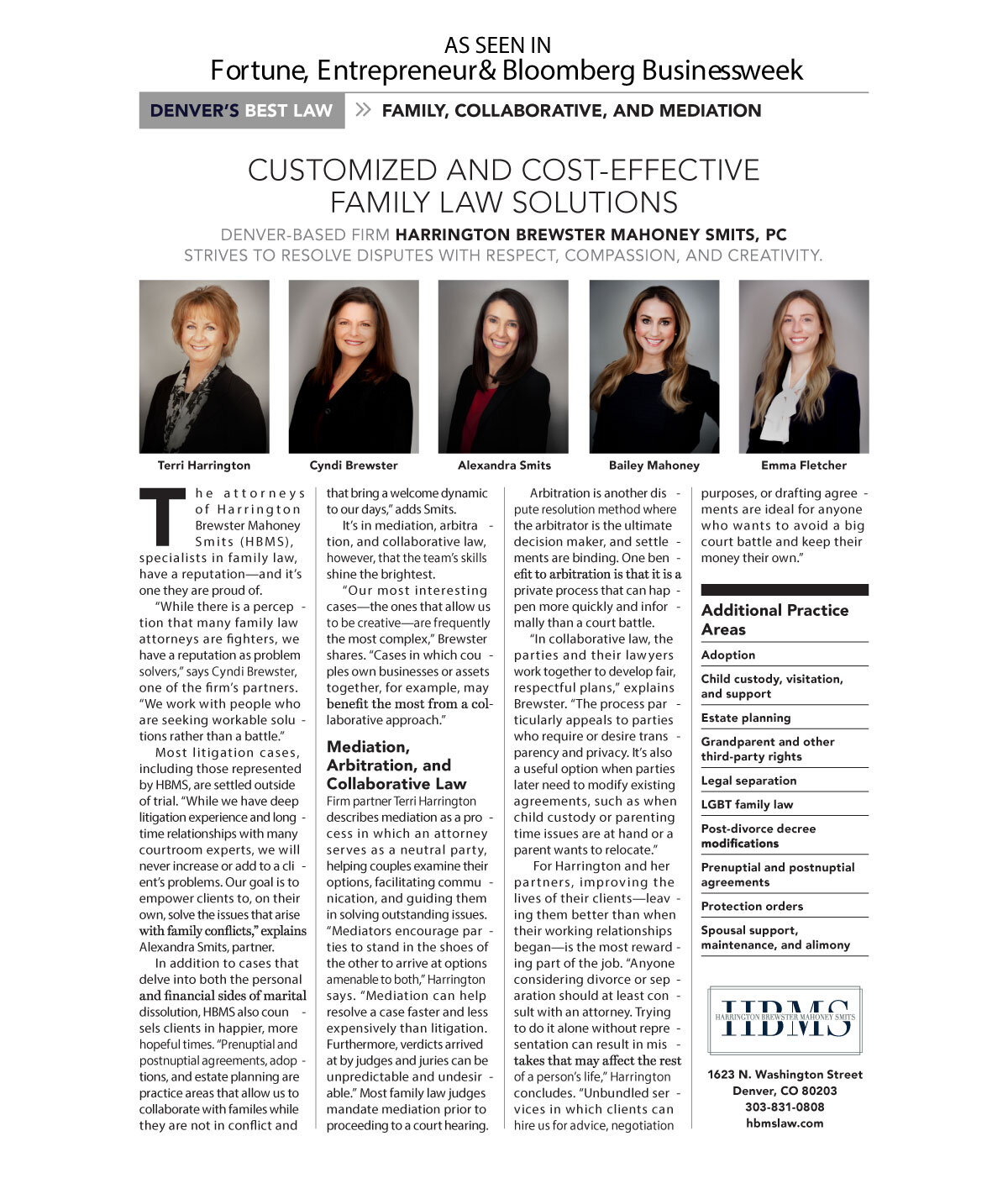
23. CRS § 15-14-413.]]>On Behalf of Harrington Brewster Mahoney Smits, P.C.<![CDATA[Us News Best Law Firms Award]]>https://www.hbmslaw.com/?p=460892023-07-21T07:33:30Z2021-10-14T07:13:42ZWe are honored to be included in this prestigious list of the Best Law Firms in the US for 2022. We express our immense gratitude to our team and clients.]]>On Behalf of Harrington Brewster Mahoney Smits, P.C.<![CDATA[COVID And Co-Parenting]]>https://www.hbmslaw.com/?p=460912023-07-21T07:33:33Z2020-10-29T07:15:02Zcontact Harrington Brewster Mahoney Smits, P.C. to schedule a call with one of our skilled family law attorneys.]]>On Behalf of Harrington Brewster Mahoney Smits, P.C.<![CDATA[Customized And Cost-Effective Family Law Solutions]]>https://www.hbmslaw.com/?p=460932023-07-21T07:33:35Z2020-05-04T07:17:41ZWe are so excited to share our feature in Fortune and Bloomberg magazines! We got the chance to talk with them about our approach to resolving family disputes with respect, compassion and creativity. The full magazines comes out in July, but you can view our feature below.
]]>On Behalf of Harrington Brewster Mahoney Smits, P.C.<![CDATA[Important Questions to ask a Divorce Lawyer]]>https://www.hbmslaw.com/?p=461002023-07-21T07:33:40Z2019-04-26T07:23:14Zclient consultations we hope to encourage a deep understanding of your unique story while also providing you with a transparent view into our process as family law experts. With over 30 years of experience, we’ve seen it all, and more importantly, we want to be the partner you need regardless of the situation.
Check out this post from the blog And Still She Persisted for some ideas.]]>On Behalf of Harrington Brewster Mahoney Smits, P.C.<![CDATA[Value of Empathy]]>https://www.hbmslaw.com/?p=460982023-07-21T07:33:42Z2019-04-26T07:21:37Zhere.]]>
 ]]>
]]>